

Intel B560 is a Disaster: Huge CPU Performance Differences and a Power Limit Mess
I've been testing a ton of Intel Z590 motherboards recently for VRM thermal performance and this has allowed me to take a look at how each board is configured out of the box. For the most part, Z590 motherboards run Intel 11th-gen processors without any enforced power limits, which is perfectly fine and within the loosely defined Intel specification.
I've found that Z590 motherboards from Asus, MSI and Gigabyte all run without power limits, or at to the lowest degree limits that will heavily restrict the performance of parts similar the Core i9-11900K. Depending on the motherboard the 11900K volition boost to, and maintain, an all-core frequency of 4.7 to 4.viii GHz.
However, Asrock follows the Intel base spec, normally referred to as the "TDP specification." What that means is the 11900K will boost up to 4.8 GHz for a flow of up to 56 seconds before dropping down to four.3 GHz, where information technology runs at a packet power of 125 watts. In other words, for sustained cadre-heavy workloads, Asrock Z590 motherboards will clock 11th-gen CPUs around ten% lower than boards from competing brands.

Still, Asrock is operating within the Intel spec, they just happen to be using the minimum specification, whereas Asus, MSI and Gigabyte are maxing that out. It's not neat, just at the end of the day, we're just talking almost a ~10% frequency discrepancy for sustained workloads and in real-life scenarios, that should typically account to little or nothing in today's games.
However, the focus of today's commodity is not Z590 motherboards, but rather Intel'south B560. These new B-serial motherboards brand a lot more sense than before on newspaper. They're now enabled for memory overclocking and with M-SKU processors being somewhat pointless due to the limited overclocking headroom, locked parts like the i5-11400 offer the near value and therefore make the well-nigh sense.
There's piddling point pairing a locked Intel CPU with a Z-series motherboard, especially at a price premium, so I decided to shift my focus towards finding the all-time value B560 boards... and what a frustrating journey that is proving to be.
I've constitute testing Intel B560 boards and then frustrating that I had to terminate testing to write this article, alert readers of the possible pitfalls when buying one such board. What I've discovered is quite alarming and something all potential Intel buyers need to be made aware of.
Depending on the B560 motherboard, functioning of locked 65 watt parts like the 11400 and 11700 tin be negatively impacted by over thirty%. That'southward right, we're non talking almost parts like the Core i9-11900K, but rather processors you volition be using with a budget B560 motherboard.
Prior to this testing, the only B560 board that I had looked at was the MSI B560 Tomahawk which we used to review and criterion the 11400F for our review. Performance was identical to Z590 boards I'd tested from the likes of Asus, MSI and Gigabyte. MSI fifty-fifty told me information technology was to be expected that B560 motherboards would offer the same level of performance every bit their Z590 counterparts, but information technology turns out that's not always the instance. Far from it.

Using the MSI B560 Tomahawk, the 11400F sustained the same iv.2 GHz all-core frequency that nosotros saw on the Z590 boards, and therefore operation remained the aforementioned. However, the Tomahawk is a $200 B560 motherboard, which is non inexpensive, and therefore the results were equally expected. I likewise tried out the Gigabyte B560M Aorus Pro AX ($180) which again mirrored the performance previously seen with the Z590 boards.

But because we were looking for the all-time budget motherboards, we wanted to run across how well the cheaper boards handled parts like the i5-11400 and i7-11700. After all, you can run a Ryzen 9 5950X without any operation restrictions on $110 AMD B550 boards like the Gigabyte B550M DS3H and MSI B550M Pro-VDH WiFi, for case.

Then I went out and purchased the Asrock B560 Pro4 which costs $125. I also have the MSI B560M Pro which should exist priced closer to $100, and the Gigabyte B560M DS3H Ac, which is some other basic lath but we haven't seen in retail nonetheless.
We fully expect entry-level Intel B560 boards to exist able to run parts like the Core i9-11900K with power limits in place (125 watt TDP spec), and of class, the motherboards are listed to officially back up the Core i9 role. What I wasn't entirely certain about was how they would configure 65w parts like the Core i5-11400F, only I did expect that it would exist possible to run the 6-cadre locked processor without power limits to achieve maximum performance, and technically it is.
Core i5-11400 Exam: Cinebench and SoTR
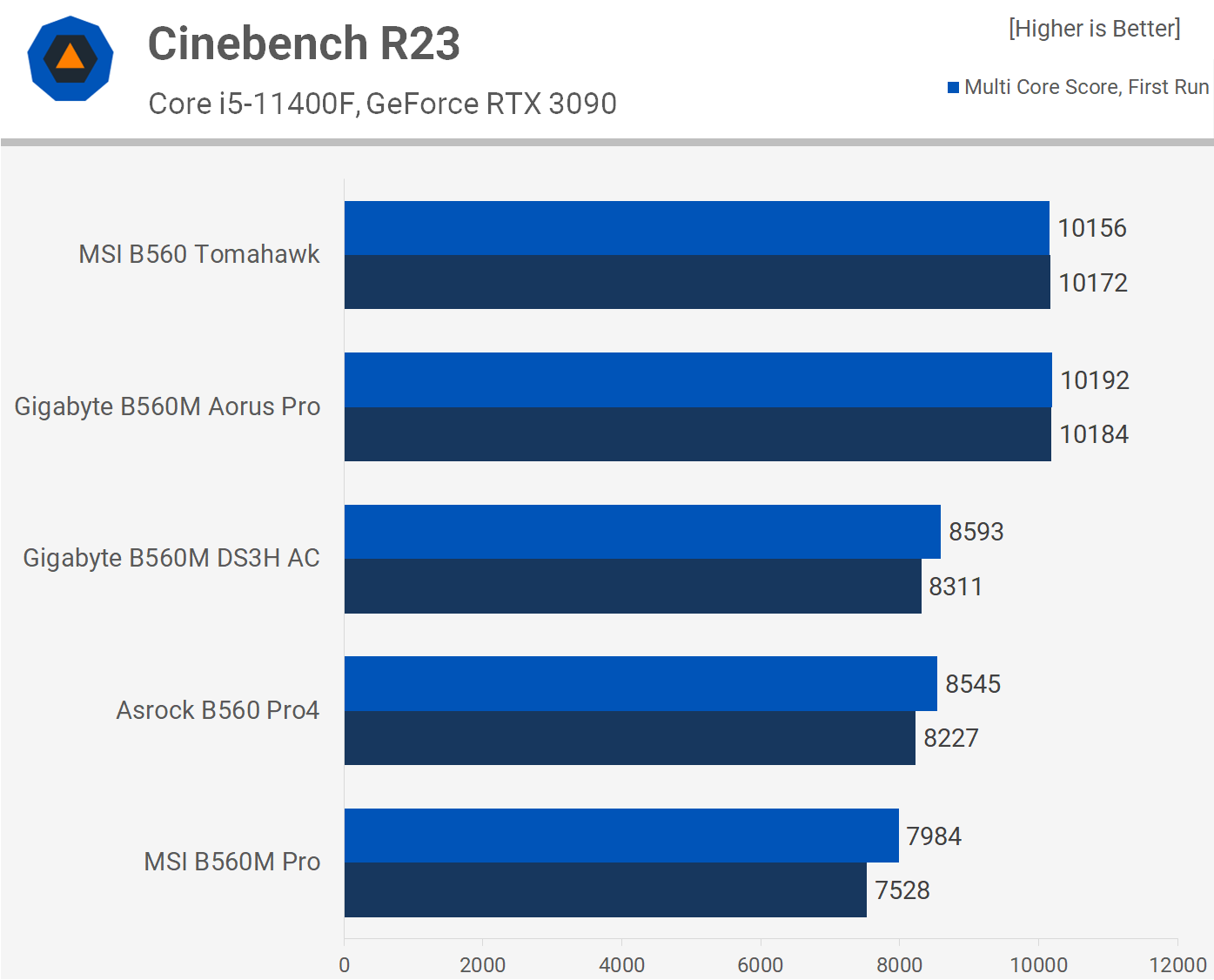
Here'due south a expect at how these motherboards perform out of the box using the Cadre i5-11400F. The $200 Tomahawk and $180 Aorus Pro AX perform every bit expected, delivering a score of roughly ten,000 points in Cinebench R23.
Both sustain an all-core frequency of 4.2 GHz out of the box. It'south also worth noting that this frequency is sustained indefinitely as long as at that place's sufficient CPU cooling, and we see that after xxx minutes of looping the multi-core exam the score remained much the same.
The more affordable Asrock B560 Pro4, Gigabyte B560M DS3H AC and MSI B560M Pro all enforce the 65 watt TDP limit past default, but that doesn't mean the aforementioned affair for all boards. Due to slight variations in voltage tuning and efficiency of the lath's VRM, the all-cadre frequency varies within that 65w envelope.
The Asrock B560 Pro4, for example, ran the 11400F at 3380 MHz. That means the Tomahawk and other B560 boards that don't enforce power limits are clocking the processor 24% higher out of the box. But the Pro4 wasn't the worst of the bunch. The MSI B560M Pro clocked fifty-fifty lower at just 3100 MHz, more than than 1 GHz lower than the Tomahawk which clocked 35% higher. And then nosotros have the Gigabyte B560M DS3H AC which maintained an all-cadre frequency of 3500 MHz, or xiii% higher than the MSI B560M Pro.
Put differently, in all-cadre workloads the B560 Tomahawk is 27% faster than the B560M Pro, or worse. The clock frequencies only mentioned were recorded at the cease of the thirty minute stress examination. So if we ignore the offset run where the B560 boards aren't running the unabridged test at the PL1 power country and wait at the result recorded later on 30 mins of looping the test, nosotros run across that the B560 Tomahawk is really 35% faster than the B560M Pro.
That's a huge performance deviation. We're talking about a different tier of CPU performance, the kind of difference you'd normally wait when upgrading from a 6 to an 8-cadre CPU of the same architecture, for example.
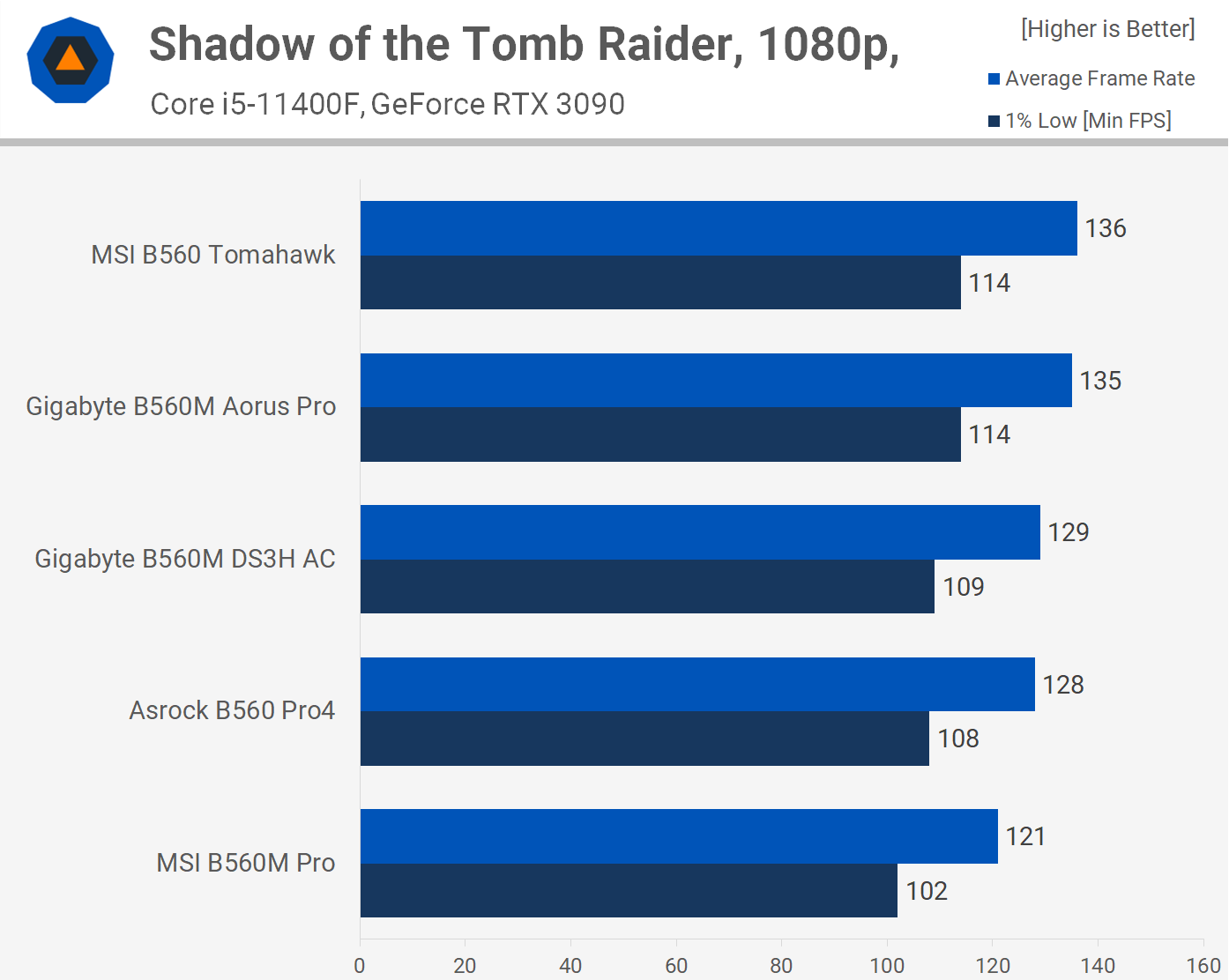
For those of y'all focused purely on gaming, the difference isn't as pregnant, at to the lowest degree in almost games that don't max out the 11400F. Testing with Shadow of the Tomb Raider nosotros come across a 12% operation uplift from the B560M Pro to the Tomahawk. That's still a reasonable difference, but not close to the 35% margin we saw in Cinebench.
It is possible to remove the power limits and unleash the 11400F on these entry-level B560 boards. How you go virtually doing this depends on the motherboard, some are easier than others. In the case of the MSI B560M Pro you simply change the cooler selection in the BIOS from 'box cooler' to 'water-cooling' and provided you have a sufficient cooler, the CPU volition boost up to 4.ii GHz for all-core workloads.
You lot might be thinking, if that's the example, what'due south the large deal and so? With the Core i5-11400F information technology's more of a nuisance than anything, and information technology will take hold of out inexperienced users who will struggle to piece of work out why their system isn't performing as claimed past reviewers and other users running better boards.
It's a bit messy, simply it'll get much worse should it come time to upgrade. The next logical step for those seeking a little extra processing ability would be a locked version of the Core i7-11700, and this is where things get very wrong...
Core i7-11700 Test: Cinebench and SoTR
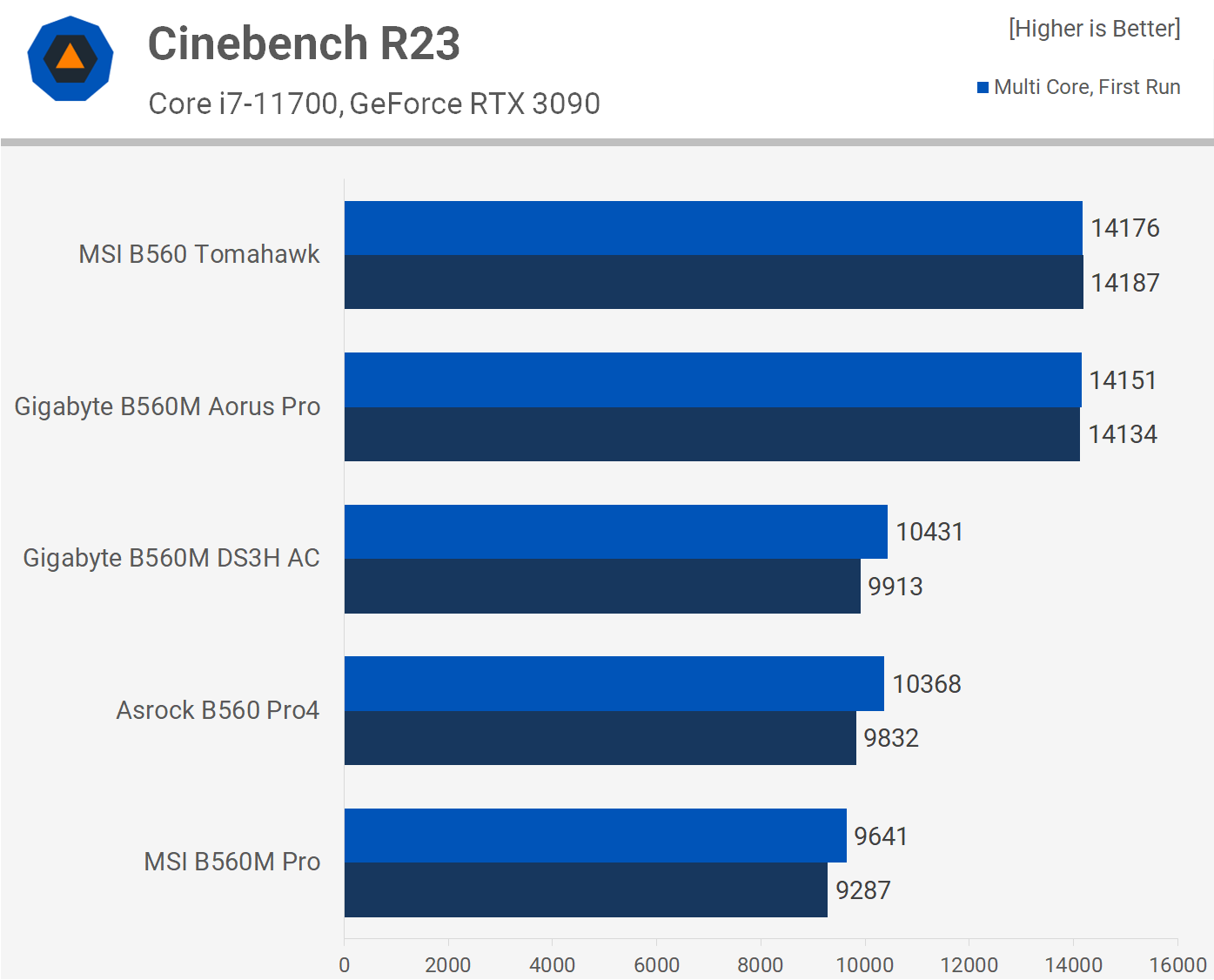
The Tomahawk and Aorus Pro run the 11th-gen processor without power limits, clocking the 11700 to 4.four GHz, which allowed for a score of just over fourteen,000 pts.
The cheaper B560 boards weren't nearly as impressive though. The Gigabyte B560M DS3H AC dropped the clock frequency in this test to 3180 MHz, so the Asrock B560 Pro4 sustained just 3155 MHz, and the MSI B560M Pro was the worst at just 2890 MHz.
Incredibly, that ways that for a sustained workload which sees Cinebench loop for xxx minutes, the Tomahawk was 43% faster than the B560M DS3H Ac and 44% faster than the Asrock B560 Pro4, that's basics. If you were to buy the MSI B560 Tomahawk with the Core i7-11700, rather than the MSI B560M Pro, yous'd accept washed well, gaining 53% more than functioning out of the box.
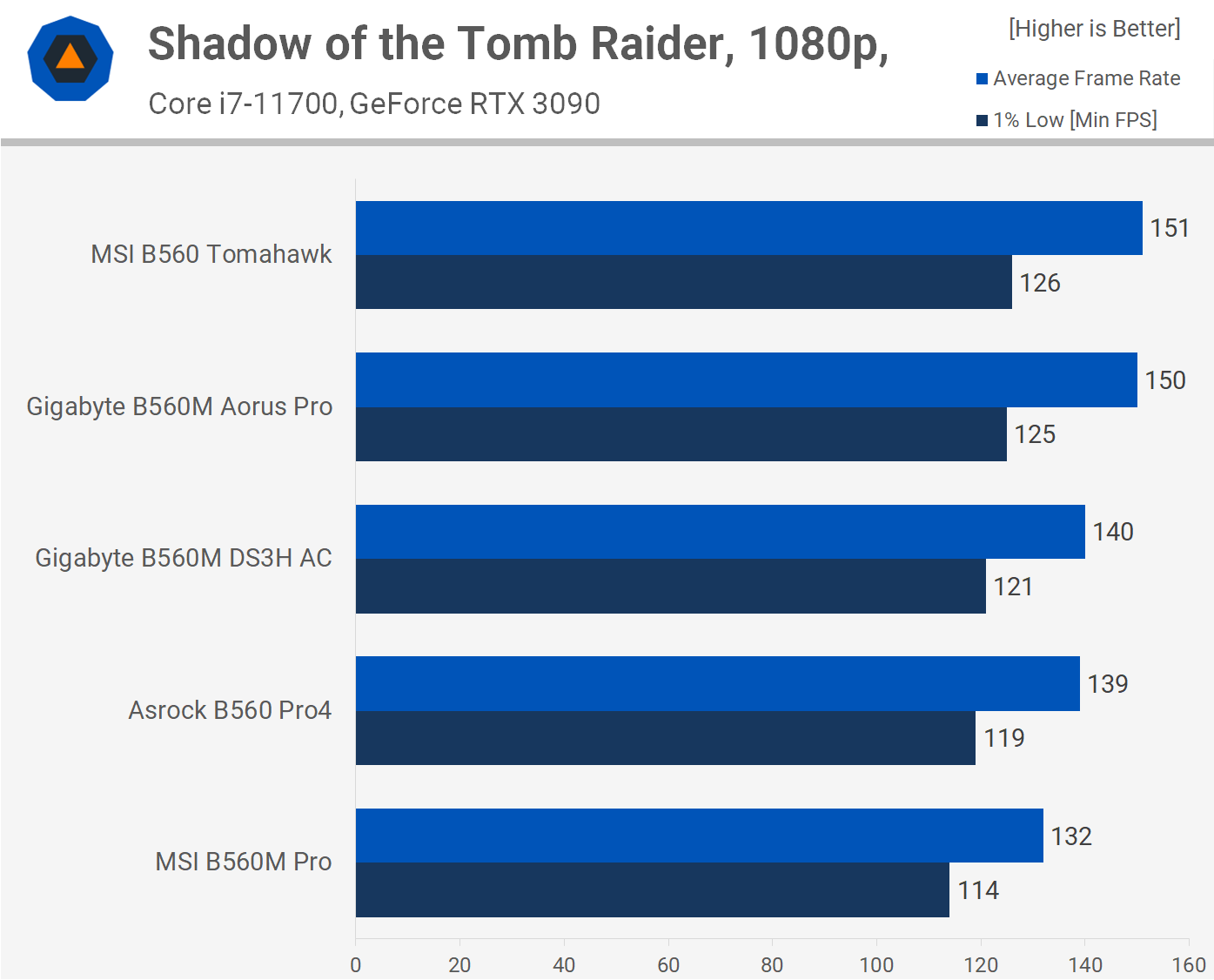
Testing gaming operation proves less demanding but this will vary on the championship. In this instance, the Tomahawk is 14% faster than the MSI B560M Pro, ix% faster than the Asrock B560 Pro4, and viii% faster than the Gigabyte B560M DS3H AC.
If we remove the power limits and allow the Core i7-11700 to run at full speed, merely as we did with the Core i5-11400F, things don't go to plan and this time nosotros run across a show stopper, motherboard VRM performance, the very thing I set out to test...
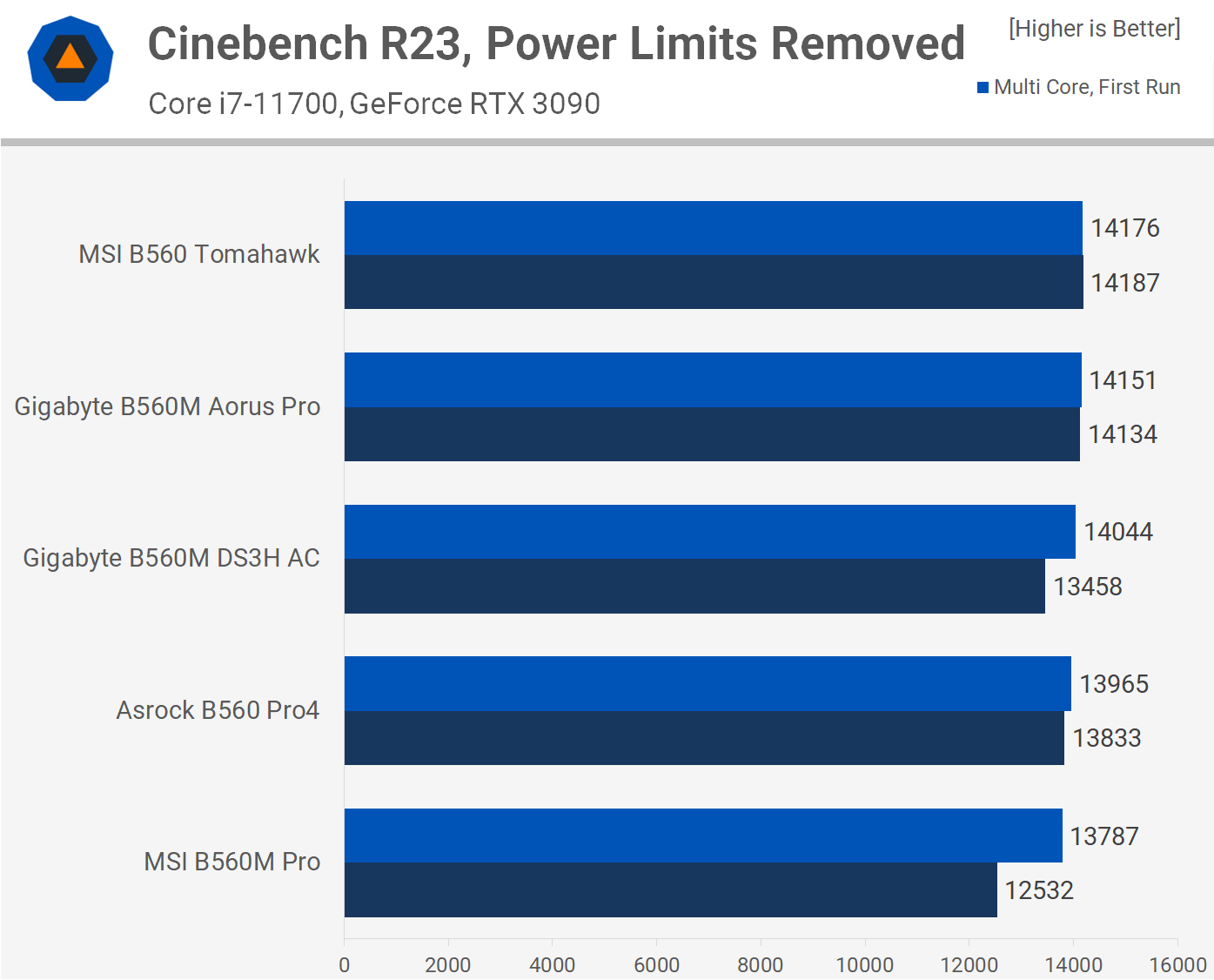
The MSI B560M Pro tin can handle a bundle power of 125 watts fairly well, but going beyond that sees the board run into trouble, forcing it to throttle the CPU to avert catastrophe. Without power limits, the i7-11700 pushes package power to effectually 140 watts, depending on the level of voltage used by the lath.
Removing the power limits on the B560M Pro with the i7-11700 installed resulted in VRM thermal throttling, and while this still saw the average clock speed raised to 3.8 GHz -- a 900 MHz boost there -- frequent dips to 800 MHz when throttling makes for a horrible feel. It also ways, fifty-fifty if we ignore the VRM throttling issue, the 11700 still clocks 16% college on boards like the Tomahawk.

The Gigabyte B560M DS3H Air-conditioning didn't avoid throttling either, though it simply periodically dropped downward to around 2 GHz, which is out of spec, and that meant the average frequency achieved was 4.1 GHz, or 300 MHz shy of the target. Interestingly, the Asrock B560 Pro4 didn't VRM throttle, but just managed 4.3 GHz with the power limits removed, though that's only a 100 MHz deficit.
The crazy part is that these boards all worked significantly better out of the box with the 125 watt Cadre i5-11600K, clocking no lower than 250 MHz below the 4.half dozen GHz all-core frequency. The reason is the college TDP, 125w upwardly from 65w, and then there's lilliputian need to remove the power limits with a part similar the 11600K, as you're only gaining around 200 MHz for heavy all-core workloads, less than a 4% drop in frequency.
Locking these boards to 125w seems like the way to go when using parts like the i7-11700, yous won't get max performance, only you lot'll get very shut while avoiding VRM throttling.
Bottom Line
We institute out that if you're willing to do a little tinkering with the ability limits, you can manually punch in most of these budget boards pretty well, but the point is that without some fairly knowledgeable user intervention, the platform is a full mess for builders.
The fact that out of the box performance tin can vary by up to 50% between B560 motherboards when using the same processor is insane. Let's clarify this is non a single motherboard manufacturer or a specific model screw up, this one's squarely on Intel.

We could fustigate MSI for making the B560M Pro, and if we did nosotros'd have to go after Asrock for the B560M-HDV, or Gigabyte for the B560M Ability, or Asus for the B560M-P, all of those boards will suffer from the same bug and there's likely more. But technically all of these boards meet the Intel spec, the base spec or TDP spec equally information technology's frequently referred to.
For their entry-level boards, each maker has ensured the VRM can handle the ability requirements of the base of operations spec, and that's nearly it. Substantially they're OEM motherboards, or rather should be OEM motherboards.
Intel 11th-gen Core i7 series

Even the MSI B560M Pro which clocks the i7-11700 as low as 2.9 GHz is within Intel'south incredibly loosely defined spec. That's because the 11700 has an official base clock frequency of but 2.5 GHz, then as long equally clocks don't drop beneath that, it's within spec. We only went out of spec with the power limits removed as this reduced the base clock nether load to 800 MHz, with VRM throttling kicking in to salve the board from thermal runaway.

In the example of the Cadre i7-11700, we had boards that sustained load frequencies of 2.9 GHz right upwards to 4.iv GHz, and Intel will tell you all are running within spec. This has been acquired past Intel'southward struggles to movement on from their 14nm procedure. The loosely defined TDP spec wasn't an issue dorsum in the Kaby Lake days when all Intel offered was a 4C/8T processor in their mainstream desktop lineup. But every bit they started to add more cores without major corrections to the TDP, we saw a gap between the base and boost clocks keep to widen.
For example, the 65w Core i7-7700 saw simply a 17% disparity between its base and boost clocks, and so with the 65w Core i7-8700 that effigy increased to 44%, and now we're at a ludicrous 96% with the Cadre i7-11700.
Intel Core i7 serial

This is the state of affairs we're faced with when recommending locked Intel CPUs on upkeep B560 motherboards. Moving frontward, my job will be to work out just how picayune you tin can spend on a B560 motherboard and all the same achieve proper functioning with parts like the Core i7-11700, ideally without having to manually fine-tune power limits.
Out of the box experience should be like the 1 offered by motherboards like the MSI B560 Tomahawk and Gigabyte B560M Aorus Pro, but without having to pay $200 for the privilege. Whether or non that'south possible remains to be seen, but we plan to accept some answers for yous in an upcoming B560 VRM benchmark feature, which will cover many more boards. Until then, it's safer to avert any sub-$140 Intel B560 motherboards.
Shopping Shortcuts:
- Intel Core i5-11600K on Amazon
- Intel Cadre i7-11700K on Amazon
- Intel Core i5-11400F on Amazon
- Intel B560 Motherboards on Amazon
- AMD Ryzen 5 5600X on Amazon
- AMD Ryzen 7 5800X on Amazon

Source: https://www.techspot.com/article/2252-intel-b560-disaster/
Posted by: wilsonpecassoo.blogspot.com
0 Response to "Intel B560 is a Disaster: Huge CPU Performance Differences and a Power Limit Mess"
Post a Comment